nebula
Fire and Ice in Auriga
IC 405 & IC 410
- Captured
- Mar 2026
- Integration
- 45 h
- Location
- Starfront Observatories
- Telescope
- Apertura 75Q
- Camera
- ZWO ASI2600MM Pro
- Views
- 32
Two Nebulae, One Frame
This patch of sky in Auriga holds two emission nebulae that sit close together on the sky but have almost nothing else in common.
IC 405, the Flaming Star Nebula, is about 1,500 light-years away. It surrounds AE Aurigae — a hot runaway star ejected from the Orion Nebula region two million years ago, now energizing an unrelated cloud it happened to encounter. Part of what you see is emission from glowing hydrogen and oxygen; part is starlight scattered off dust. That dual nature — emission and reflection — gives IC 405 its layered character.
IC 410 sits much farther away at around 12,000 light-years. Its hot young stars have carved a cavity in the surrounding gas and are slowly eroding the material around them. The two elongated pillars pointing inward toward the cluster center are the namesake tadpoles — dense knots that are eroding more slowly than the surrounding gas, gradually being worn away by radiation and stellar winds.
Capturing It
The image represents 45.6 hours of integration across seven filters captured remotely from Starfront Remote Observatory in Texas over six weeks. The mono ASI2600MM with Antlia 3nm narrowband filters lets each emission line be captured and weighted independently — hydrogen-alpha received the most time at 14.3 hours, given the faint outer filaments of IC 405 that needed depth to emerge.
Three Versions
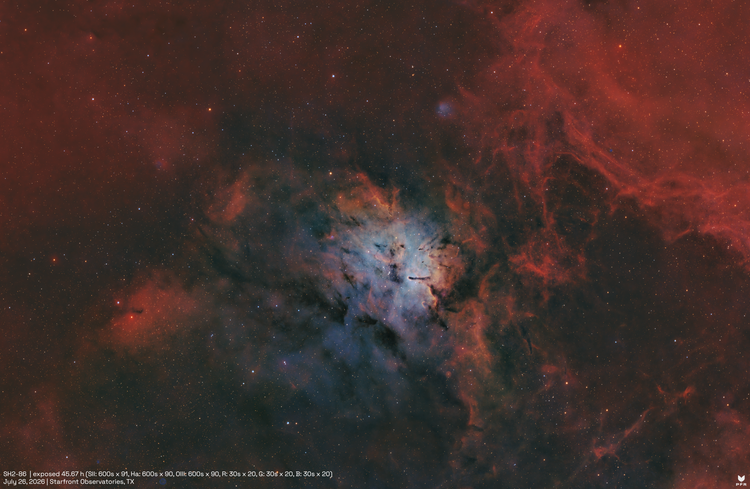
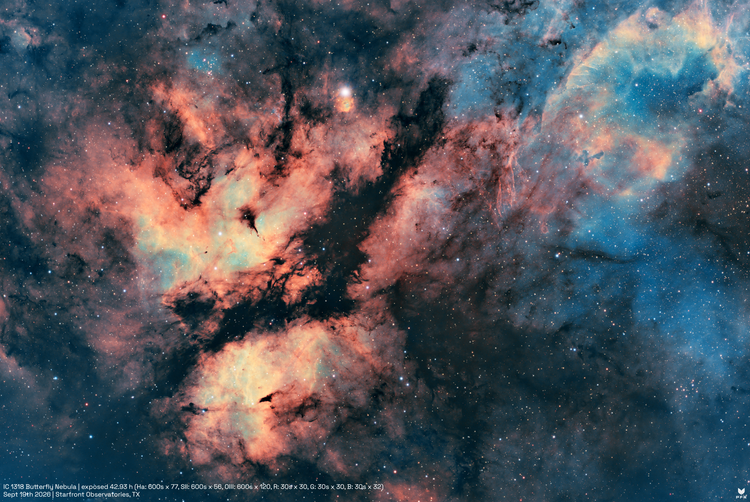
The primary image uses the Hubble palette (SHO): sulfur-II mapped to red, hydrogen-alpha to green, oxygen-III to blue. It's false color, but it encodes real chemistry — the warm gold of IC 405 reflects its sulfur-II emission, while IC 410's blue-dominant tones reveal its stronger oxygen-III content.
The broadband versions tell a slightly different story. Reflection nebulosity — scattered starlight — doesn't emit in narrowband wavelengths, so the blue-white glow at the heart of IC 405 simply disappears in the SHO render. The HaLRGB and HaRGB versions recover it by blending in the RGB data, giving a more complete picture of what's actually happening around AE Aurigae.