
The Great Orion Nebula: Measuring Progress in Imaging and Processing

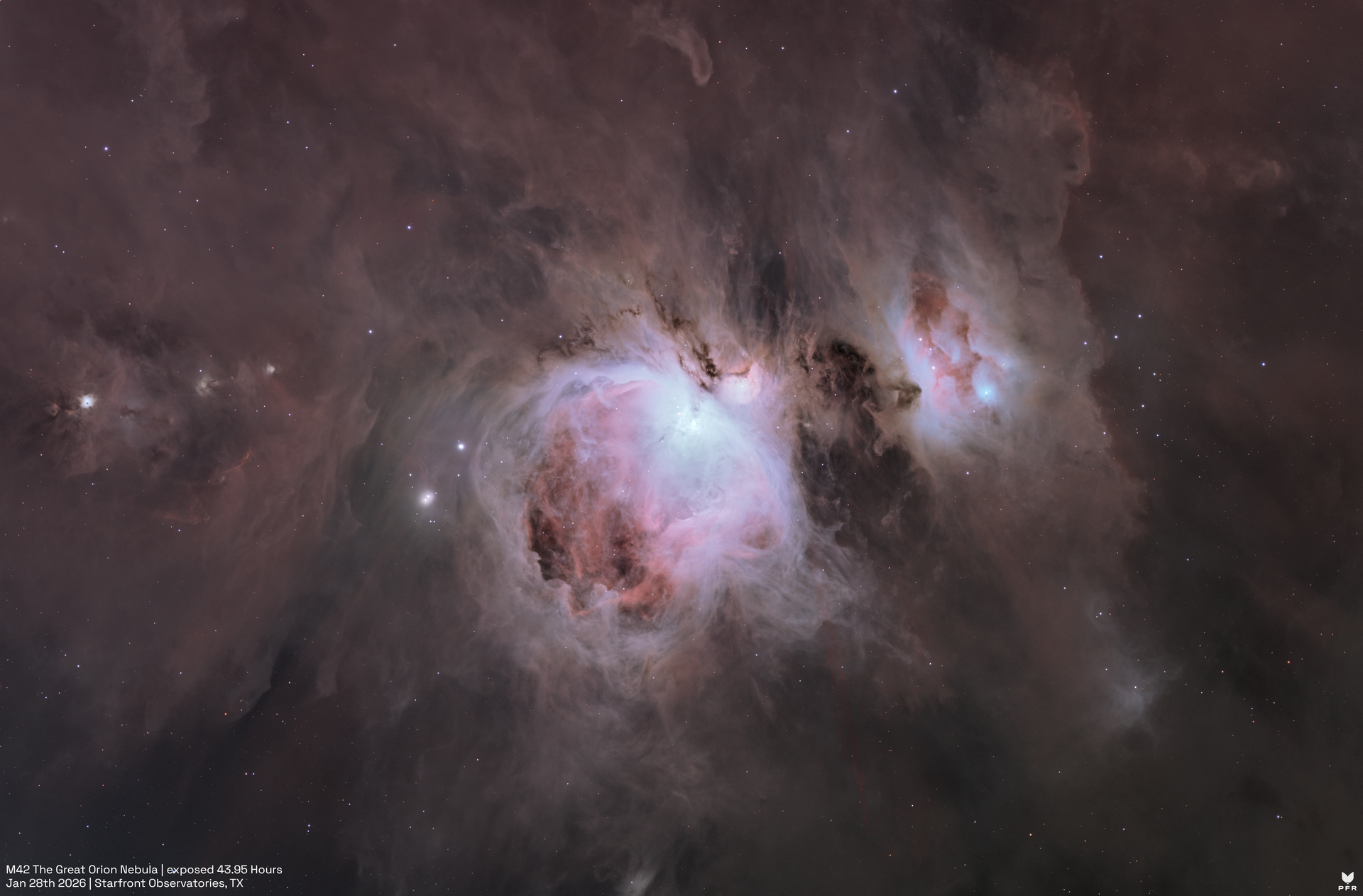
The Orion Nebula has quietly become a way for me to measure my own progress in astrophotography — not just in the equipment I use, but in how I think about data, processing, and restraint.
This post isn’t about chasing a “perfect” image of a famous target. It’s about what changes when you revisit the same object with more experience, more intention, and a better understanding of how far you can push — and when you shouldn’t.
First Light: Discovery

The first image I ever took of the Orion Nebula came from my Vaonis Vespera 2, the telescope that introduced me to this hobby in the first place.
That image wasn’t noisy or unusable — far from it. What it lacked wasn’t quality, but depth. With a relatively short integration time and a smart, all-in-one system, the image captured the bright heart of Orion beautifully, but the surrounding dust and cloud structures simply weren’t there yet.
At the time, I didn’t know they could be there.
That image represents discovery — learning how to frame the sky, how targets change through the night, and how astonishing it is that you can capture something like this from the ground at all.
Second Pass: Control

The second Orion image came later, using a Carbonstar 200 paired with an ASI2600MC Air, taken on a short trip where I had limited time but much more control.
This version was built using a combination of:
- 180-second exposures for depth
- Shorter 30-second and 10-second exposures to protect the bright core
This was my first real step into managing dynamic range intentionally. The nebula became smoother, more detailed, and more structured — but also more zoomed in due to the focal length of the scope.
Processing this image taught me something important: improving results wasn’t just about collecting more data, but about choosing the right data and understanding how different exposure lengths interact.
Third Pass: Discipline
The latest Orion image is the most demanding project I’ve processed to date.
It was captured remotely at SFRO using my Apertura 75Q, paired with a ZWO ASI2600MM Pro and Antlia LRGB, H-alpha, and OIII filters. This was only the second time I’ve fully leveraged luminance data in an image — and that choice made all the difference.
Luminance filters don’t add color. Instead, they capture pure structure. The faint dust and extended cloud surrounding Orion finally emerged because the image wasn’t relying on color channels to do structural work they weren’t designed for.
In total, this project represents:
- Multiple luminance exposure lengths
- RGB data at different depths
- Narrowband H-alpha and OIII captured at long exposures
- Roughly 45 hours of total integration
- Nearly 3,000 individual subframes
At this scale, processing stops being about “making the image pop” and becomes about preventing the data from falling apart.

Building the Final Image
To combine everything into a single coherent result, I relied on several advanced PixInsight processing techniques:
- HDRComposition was used to merge multiple exposure lengths into a single high dynamic range image, preserving the bright core while retaining faint outer structure.
- HDR Multiscale Transformation helped gently compress dynamic range without destroying contrast or introducing harsh transitions.
- SHO-AIP was used as a flexible blending tool to bring together luminance, RGB, and narrowband data in a controlled, iterative way.
None of these tools are difficult on their own. What made this project challenging was the interaction between them. With this much data, small mismatches in noise, scaling, or background levels quickly become visible. Several versions technically “worked” while looking worse than images with a fraction of the integration time.
Knowing when to stop — and when to back up — became just as important as knowing which process to run next.
What Orion Taught Me This Time
This image taught me more than any single processing tutorial ever has:
- More data doesn’t automatically make processing easier
- HDR requires restraint as much as technique
- Luminance is a structural tool, not just a brightness boost
- At some point, finishing an image matters more than perfecting it
For a first light with a new camera, Orion was a brutal choice of target. But it was also the right one. Revisiting the same object at different stages made the progress tangible — not just in the final image, but in how confidently I approached the problems along the way.
This won’t be my last image of the Orion Nebula.
But for now, this chapter feels complete.
Clear skies.
Discussion
Loading