
Back Under the Stars

It's been a while, and I've missed it. Most of my astrophotography comes from my remote rig at Starfront, but Texas spring weather has not been kind. Between the clouds, the high humidity, and the storms, the observatory hasn't been open nearly as much as I'd like. None of it is in my control, so I've made peace with it and grabbed what light I can between systems.
Waiting Out a Texas Spring
There's work in progress out there, even if it's coming together slowly. I've been collecting on a dark nebula, LDN 169, and I'm nearly finished with my integration of the Iris Nebula. I've also started scheduling the summer lineup: M8 and M20, and then M16 with the Pillars of Creation.
M16 is the special one. It's the object that first lit my curiosity about space as a kid. Ever since the Hubble image of the Pillars came out I've been hooked, and the fact that I can now put together something in that same spirit myself still genuinely excites me. There's a strange kind of joy in chasing an image that shaped you before you ever owned a telescope.
The frustrating part is that I haven't been able to finish a single one of those observatory projects. The weather keeps cutting nights short and leaving me with partial stacks. So this past weekend, with clear moonless skies here at home, I decided to stop waiting on Texas and take matters into my own hands.
A Thirty-Minute Drive to Dark Skies
I don't have a backyard I can set up in, which means every session is a drive and a full teardown and rebuild somewhere dark. There's no rolling the scope out the door and being imaging in ten minutes. Everything gets packed, hauled, leveled, aligned, and focused from scratch, and then torn back down at the end of the night.
Luckily, about thirty minutes from me is a Bortle 3 site at Camp Floyd in Fairfield, Utah. The local astronomy clubs use it as a regular spot for visual observing, and it's a genuinely beautiful place to point a camera at the sky. Dark enough to make the drive worth it every time.
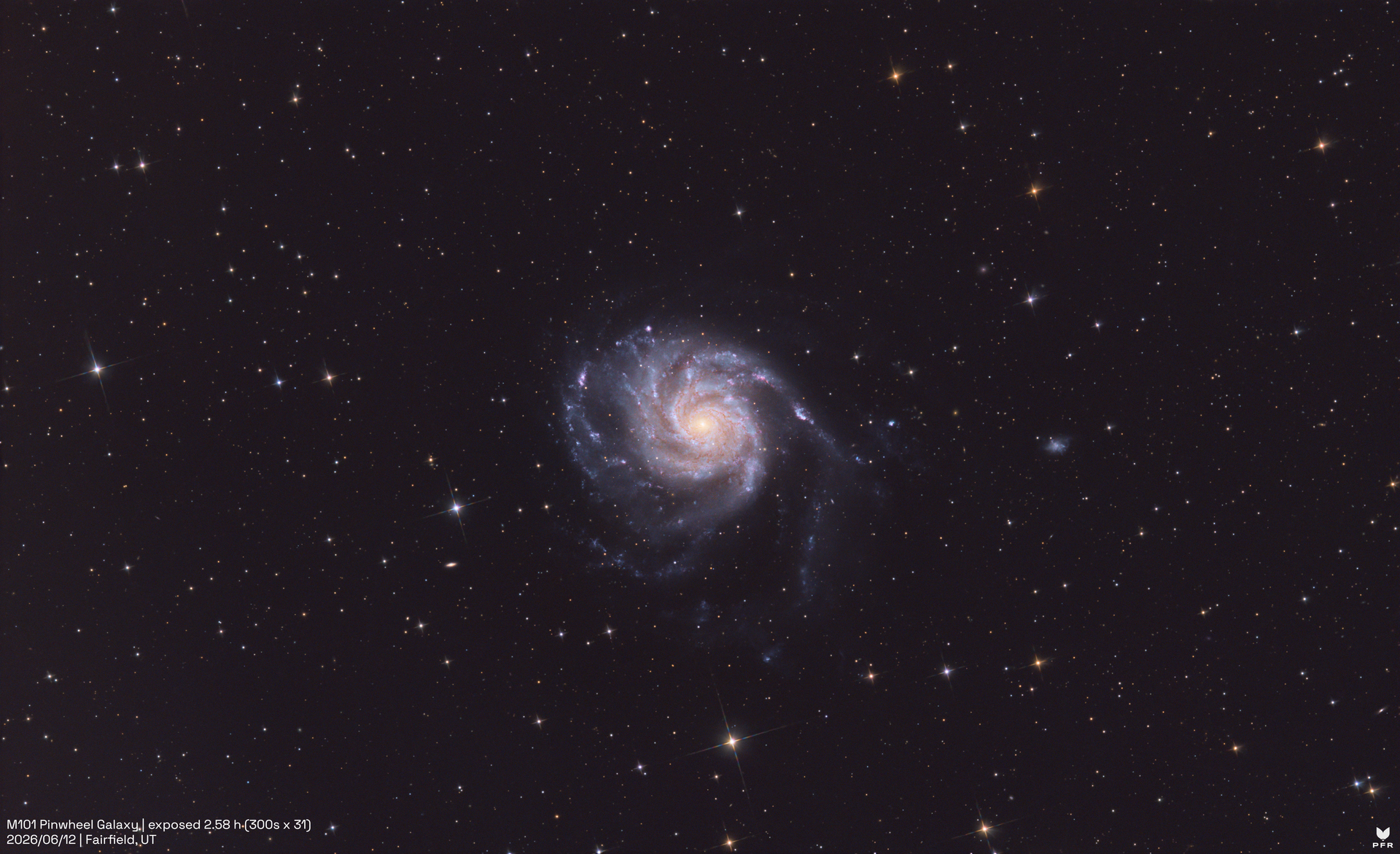
I set my sights on M101, the Pinwheel Galaxy. It's a grand face-on spiral about 21 million light-years away in Ursa Major, and it's a big one, spanning close to 170,000 light-years, nearly twice the diameter of our own Milky Way. Its arms are studded with bright pink knots of hydrogen where new stars are being born, which is part of what makes it such a rewarding target. It had been a while since I'd pulled out the Newtonian, and this felt like exactly the right reason to bring it back out.

I unpacked everything, leveled the mount, and then spent far too long on polar alignment. That's the skill I most need to sharpen, and standing out there under a clear sky watching the minutes tick by is good motivation to get faster. Once I had focus dialed in and guiding running, the better part of an hour had gone by before I was finally collecting light. I managed about ninety minutes of data before packing up and heading home.
Two Nights, Two Targets
The next night cooperated too, and I came back ready to make better use of it. I set up earlier and moved through polar alignment much faster this time. While I was getting going, I noticed a few other astronomers out there with big Dobsonians, taking advantage of the cluster of planets sitting low after sunset. Venus, Jupiter, and Mercury were all hanging together in the west, and it was a great reminder of how much there is to look at even without a camera involved.
I settled in for a few more hours on the Pinwheel. Then, near the end of the night before I left, I switched things up to grab 30 to 40 minutes on M13, the Great Globular Cluster in Hercules. It's a tightly packed ball of a few hundred thousand stars sitting roughly 22,000 to 25,000 light-years away, and it ranks among the oldest objects in our galaxy at over 11 billion years old. It's also the cluster astronomers aimed the famous 1974 Arecibo message at, our first deliberate radio hello to the stars.

I hadn't processed a project in months, and I figured if I could walk away with even one finished subject from the weekend I'd leave a happy person. So I did. By the end of the two nights I had roughly 35 minutes on M13 and three hours on M101.
That's not amazing integration time compared to the 50 to 100 hour projects I run from the observatory. But it was enough to remind me why I love this, and enough to get me excited for Milky Way season and for the Texas weather finally letting up into proper imaging conditions this summer.
I love this hobby. I wish I had a backyard to set up in more often, but you do what you must, and I enjoy every minute of it as much as anyone else does.
-Clear Skies
Discussion
Loading